
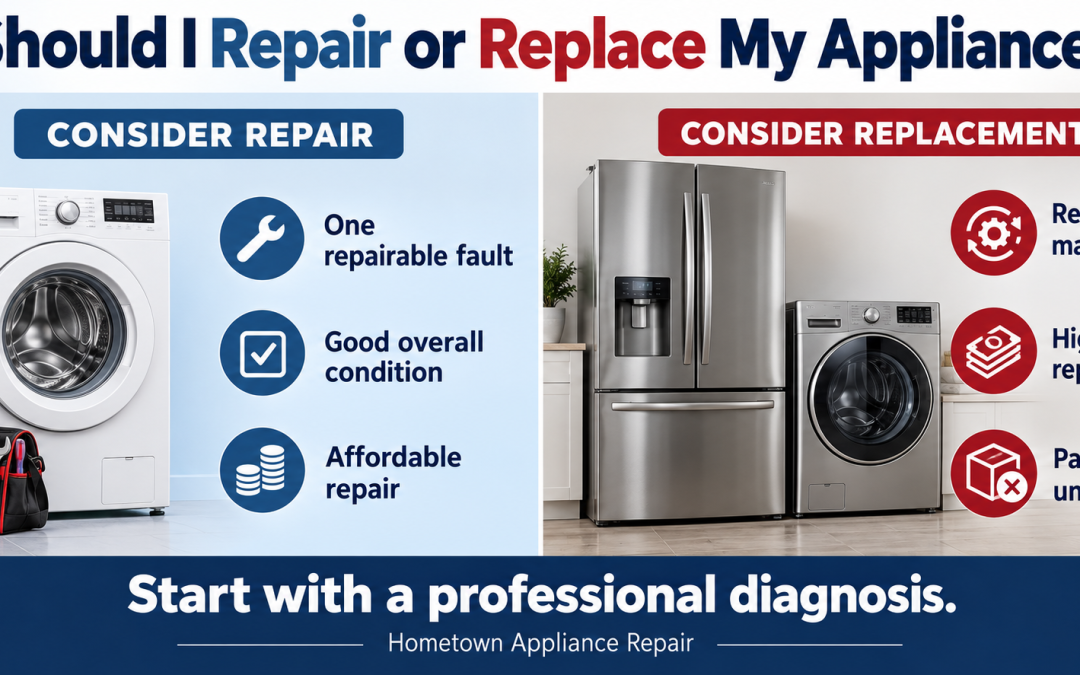
A washer stops spinning, the refrigerator will not stay cold, or the oven quits heating before dinner. Your first question may be how quickly you can get it working again. The next question is often more difficult: Should I repair or replace my appliance?
The answer depends on the problem, the appliance’s overall condition, the cost of repair, and what replacement would actually involve. One failed component does not automatically mean an appliance is worn out. At the same time, investing in repeated major repairs may not make sense for your household.
Hometown Appliance Repair helps Central Kentucky homeowners understand appliance problems and make informed service decisions. A professional diagnosis gives you a practical starting point for comparing your options.
Before ordering a replacement or buying parts, consider the following factors.
Repair or Replace My Appliance? Start With the Diagnosis
A symptom tells you what the appliance is doing, but it does not necessarily identify the cause.
A dryer that will not heat, for example, needs assessment before anyone can recommend a particular component. A refrigerator that feels warm also needs more investigation than simply assuming its compressor has failed.
The first step is to establish:
-
What is causing the problem?
-
What work would correct it?
-
Are the necessary parts available?
-
What will the proposed repair cost?
-
Are there other significant concerns with the appliance?
These answers turn a stressful decision into a comparison you can evaluate.
When contacting Hometown Appliance Repair about appliance service, describe the symptoms, provide the model number if accessible, and explain when the problem began. You do not need to diagnose the appliance yourself.
Compare the Full Repair Cost With the Full Replacement Cost
Comparing a repair estimate with an advertised sale price can give you an incomplete picture.
A replacement appliance may involve delivery, installation, removal of the old unit, and necessary installation accessories. Depending on the equipment and your home, additional work may also affect the total.
Before deciding, ask for an itemized understanding of both options.
For repair, clarify whether the estimate includes diagnosis, parts, labor, and applicable fees. Ask whether the diagnostic charge is separate or credited toward approved work.
For replacement, consider:
-
The appliance purchase price.
-
Delivery and installation charges.
-
Removal or recycling fees.
-
Required hoses, cords, or installation kits.
-
Any necessary cabinet, plumbing, electrical, or venting changes.
Hypothetical example: A homeowner receives a $300 repair estimate and finds a replacement advertised for $800. After delivery, installation, and removal, the replacement total reaches $1,050. The useful comparison is $300 versus $1,050, considered alongside the existing appliance’s condition.
These figures are illustrative and are not Hometown Appliance Repair prices.
Consider Age Alongside Overall Condition
Age matters, but it should not make the decision by itself.
Two appliances purchased in the same year can have different repair histories and levels of wear. One may have served a small household with light use. Another may have handled several loads every day.
When asking, “Should I repair or replace my appliance?” consider how it performed before the current problem.
Did it complete cycles reliably? Were you satisfied with its performance? Does it have significant rust, damaged components, or several unrelated faults? Has it received the maintenance recommended in its owner’s manual?
An older appliance with one repairable problem may still meet your needs. A newer appliance with extensive damage may present a different decision.
Ask the technician whether the current fault appears isolated or whether other visible concerns should influence your choice. An assessment can inform the decision, although nobody can guarantee exactly how long an appliance will last afterward.
Review Its Repair History
Previous repairs provide useful context, particularly when the same symptom keeps returning.
One repair several years ago is different from multiple recent service visits. However, the number of visits alone does not tell the whole story.
Ask whether earlier repairs involved the same system or unrelated components. Explain which parts were replaced, when the work occurred, and whether performance improved afterward.
For example, a recurring drainage problem deserves an explanation of why it returned. Buying a replacement may not resolve a problem caused by a household drain or installation condition.
Keep the focus on the appliance’s current condition and the likely value of the proposed work. Money already spent cannot be recovered, so it should not be the sole reason to authorize another repair.
Check Warranty Coverage and Recalls
Before paying for a major repair or purchasing a replacement, review the appliance’s paperwork.
Find the purchase date, model number, serial number, and warranty information. Ask the manufacturer whether the particular problem has coverage and how to request that covered service.
The Federal Trade Commission’s warranty guidance explains the importance of reading coverage details and distinguishes product warranties from separately purchased service contracts.
If you purchased a service contract, check its terms, charges, exclusions, and claim procedures. Do not assume every repair is included.
Also search the U.S. Consumer Product Safety Commission’s recall database for your appliance. If it is affected, follow the specific recall instructions and contact information before arranging ordinary repair or replacement.
A recall can change your next step, so it is worth checking the exact model rather than relying only on the brand name.
Ask About Parts Availability and Timing
A worthwhile repair also needs a practical path to completion.
Ask whether the required part is available, whether an estimated arrival date is known, and whether the repair requires a return appointment.
A short wait may be manageable for one appliance. It may be more disruptive for a refrigerator or the only washer in a busy household.
Replacement has its own timing questions. A model listed online may not be ready for delivery, and installation availability can affect when you can use it.
Compare realistic timelines for both options. Temporary arrangements, such as laundromat visits or alternative cold storage, may influence which choice works best for your family.
Evaluate Energy Efficiency Without Assuming Savings
A replacement appliance may offer efficiency benefits, but those benefits should be evaluated using the specific models involved.
The FTC’s EnergyGuide explanation describes how the yellow label helps shoppers compare appliance energy use and estimated operating costs.
For refrigerators and freezers, the ENERGY STAR Flip Your Fridge calculator provides estimated savings associated with replacing or removing older equipment. ENERGY STAR notes that actual savings depend on use, upkeep, and other factors.
Efficiency belongs in the comparison, particularly for equipment used frequently. However, a lower estimated annual operating cost does not automatically make replacement the more economical choice.
Consider the upfront difference, how long you expect to use the appliance, and whether the replacement offers a meaningful improvement for your household.
The Decision Can Differ by Appliance
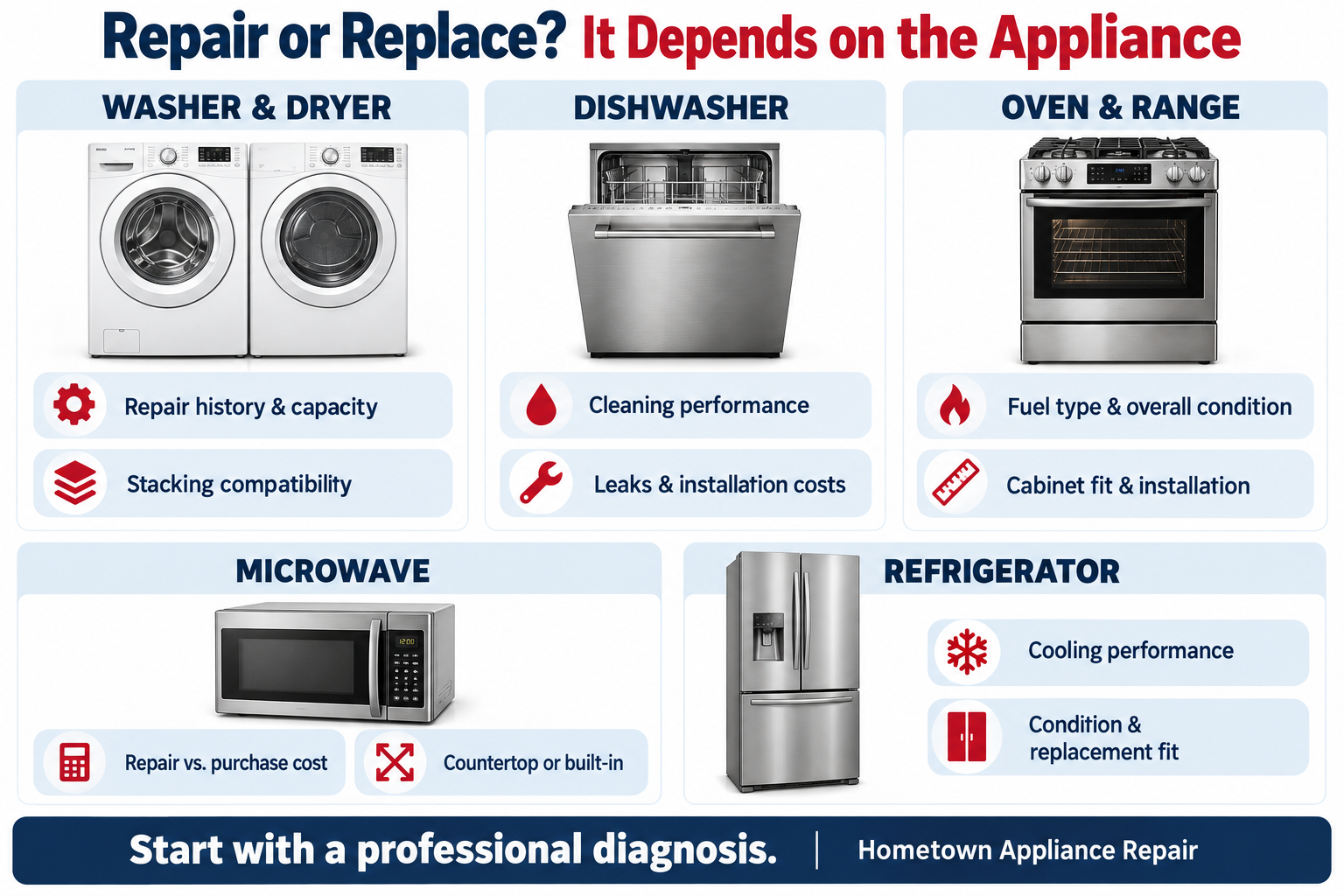
The question “Should I repair or replace my appliance?” looks different depending on the equipment and how it fits your home.
Refrigerators and Freezers
Consider cooling performance, the diagnosed fault, storage needs, and installation fit. Replacement dimensions matter, including door clearance and the path through your home.
Protect food appropriately while arranging service. The food-storage decision should not wait for the repair-versus-replacement decision.
Washers and Dryers
Consider capacity, repair history, installation, and whether the appliance is stacked or part of a combined unit.
If only one machine needs replacement, confirm compatibility before assuming it can be stacked with the existing equipment.
Dishwashers
Compare the diagnosis with the machine’s cleaning performance, physical condition, and installation costs. A leak or drainage concern needs a clear explanation before you decide that replacement will solve it.
Ovens and Ranges
Consider fuel type, installation requirements, and whether the equipment is built into cabinetry. Replacing a built-in oven can involve different costs from replacing a freestanding range.
Microwaves and Garbage Disposals
Purchase price can be an important part of the comparison, particularly for a countertop microwave. Built-in and over-the-range equipment may involve additional installation considerations.
For every appliance, ask what makes the proposed repair worthwhile for that specific model.
When Repair May Be the Better Choice
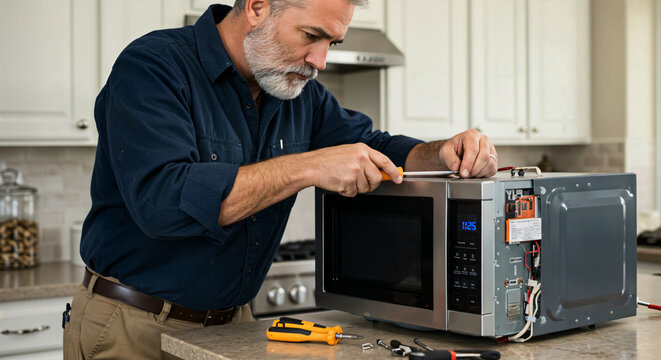
Repair deserves consideration when the problem is identifiable, the required work is reasonably priced, and the appliance otherwise meets your needs.
It may be especially practical when parts are available and replacement would create substantial installation costs.
Ask what the repair is expected to restore and whether there are known additional concerns. You should understand the recommendation before approving the work.
When Replacement May Be More Practical
Replacement deserves closer consideration when there are several major problems, the required parts are unavailable, or the total repair cost is difficult to justify against a suitable replacement.
Your household’s needs matter too. If the appliance no longer offers the capacity or functionality you require, replacing it may address more than the current breakdown.
Avoid relying on a single percentage rule or age cutoff. A useful decision considers the complete situation.
How Hometown Appliance Repair Can Help
Hometown Appliance Repair offers a local starting point for discussing malfunctioning household appliances and the next step toward diagnosis.
Owner Terry Paige’s approach to customer care emphasizes fair treatment, dependable workmanship, and lasting customer relationships.
Before scheduling, explain the problem and provide the appliance information you have available. Ask about diagnostic charges, service availability, and how repair recommendations will be communicated.
Once the problem is understood, you can compare the proposed work with replacement costs and decide what fits your priorities.
Get Help Deciding Whether to Repair or Replace Your Appliance
If you are wondering, “Should I repair or replace my appliance?” start with the facts: the diagnosis, repair estimate, overall condition, coverage, parts availability, and full replacement cost.
Contact Hometown Appliance Repair or call 859-249-0933 to discuss your appliance and request service.
A clear assessment can help you choose a practical solution for your home, your schedule, and your budget.